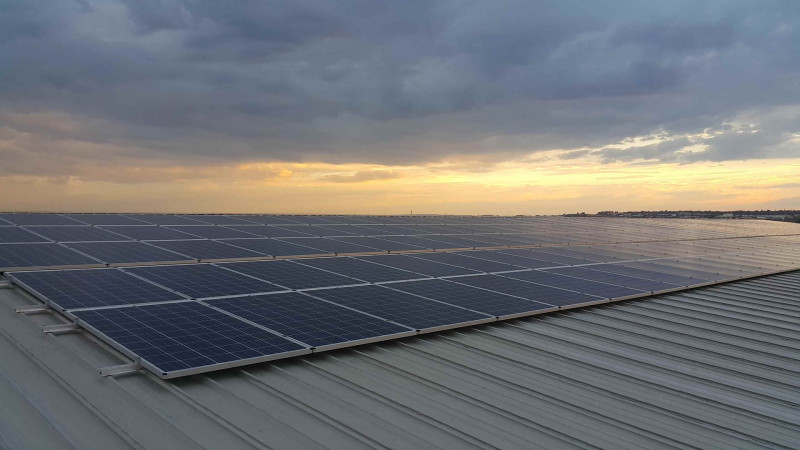
Efficient homes is something that many have heard of but perhaps few know what exactly it is about. An efficient home allows you to save energy - but we're not just talking about turning off lights that we don't need on or closing windows to keep out heat or cold. To be considered an efficient home, it must reduce unnecessary energy consumption and greenhouse gas emissions. And, to build or remodel such a house, it is necessary, among others, to incorporate thermal insulating materials in the walls, ceilings, doors and windows, as well as the use of renewable energy sources, such as solar panels and electricity storage systems.
Energy efficiency is a priority and, therefore, the European Commission is determined to achieve a zero-emission building stock by 2050. It is necessary to take into account that the construction of buildings represents around 40% of carbon emissions.
But are these ambitious goals for Portugal? “In fact, we have until 2030 to guarantee a construction with zero carbon emissions and many of the projects that are underway today do not foresee this”, Nuno Garcia, director general of GesConsult, begins by explaining to i. Therefore, he says that “it is very unrealistic for the new goals to come out of paper and to materialize in the space of just eight years. Until 2050 may seem like a long time, but we are talking about two generations of projects”.
A real race against time, and the expert argues that “if the current mentality does not change now and the implementation of new solutions is not immediate, this interval will not be enough to think about projects, define implementations and achieve the goals that are defined”.
Although sustainability “is a 'hot' topic at the moment, and even serves as a differentiating factor for some projects, we are just taking the first steps in the matter, there is a long way to go, which needs to be widely disseminated, so that from here within 10-15 years, all works are aimed at the 2050 requirements”, points out Nuno Garcia.
Enough supports? To help improve the energy performance of private homes, the Government has some support within the scope of the Recovery and Resilience Plan (PRR), such as the Efficiency Valley and the Sustainable Buildings Program which, with data up to May , had already exceeded 106 thousand applications. And the Government decided to increase the allocation to a total of 96 million euros.
Asked whether this support is sufficient, Nuno Garcia argues that “in terms of sustainability, there are always too few incentives. Traditionally, they have an inappropriate limit to what the individual has to invest, and the conditions for achieving this are so bureaucratic that they end up alienating those who seek them”. Incentives, he argues, “have to be thought of on a real scale and most projects are not large enough to have an impact”.
So is more support needed? “Clearly yes, even to diversify and massify solutions”, defends the official, who draws attention to the fact that this support may not even be direct. “Not paying so many taxes, receiving exemption in some fees, obtaining benefits in licensing, following a green taxation - all these are indirect forms of incentive”, remembering that, in addition, “the communication that is made of the support created to stimulate sustainability also can be reinforced, so that more and more people have knowledge and compete”.
At a time when temperatures are ever higher, an efficient home becomes more and more a necessity - just like in winter with low temperatures.
Nuno Garcia analyzes: “We are the fourth European country with the highest energy poverty, which means that a high share of the domestic budget is channeled to energy bills, and even so, we are unable to keep our homes warm during the winter and fresh in summer”. With extreme temperatures, he says, “this reality is even more noticeable, because we can't get thermally comfortable houses and we spend a lot of energy heating them up”. Thus, he argues that “there must be a large investment in our housing stock, to guarantee decent conditions of habitability, while consuming less energy and reducing carbon emissions”.
More expenses And, if for families, making a home efficient brings extra costs, for companies it is no different. “It is undeniable that the financial impact exists”, says Nuno Garcia. “And as there are still no mass solutions, this cost is high”.
In his opinion, the path involves “finding solutions with less impact, with the help of technological developments to minimize it”.
And he warns: “We can't wait until we don't have water in the taps to realize that the cost of this lack is much higher than the expense we pay on the bill. But it seems to me that there is still no idea of the impact that will be felt when we have to ration resources because they are simply no longer available”.
Asked if efficient homes are nothing more than a mirage in Portugal, Nuno Garcia is peremptory: “I think that in their fullness, efficient homes are, in fact, a mirage, insofar as there are no projects that fulfill the entire check-in. list associated with sustainability”.
And he says that it is necessary to combine construction techniques and methods, associate technological systems, think about the expenses in the entire construction cycle and use of buildings (sustainable materials, insulation, water and energy use) “and this is not massified”. “In addition to looking at the projects as a whole, the tendency also has to become global among promoters and there is natural resistance to this”, concludes the director general of GesConsult.
Font: Sol